
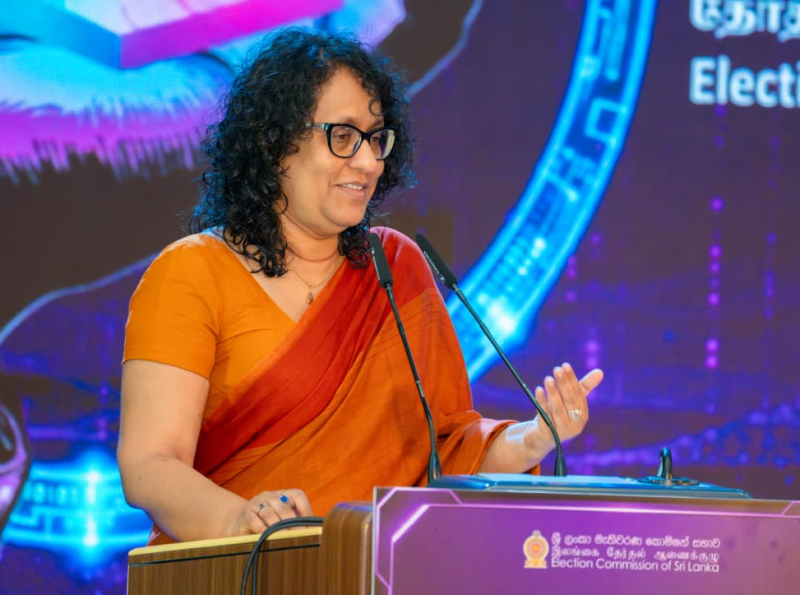
rime Minister Dr. Harini Amarasuriya stated that Sri Lanka, with a 95-year legacy of universal suffrage, has embarked on a new path strengthened by technology and firmly grounded in the rule of law.
The Prime Minister made these remarks while addressing a special commemorative event organised by the Election Commission to mark the International Day of Democracy, held on September 15 at the Centre for Banking Studies of the Central Bank of Sri Lanka in Rajagiriya.
A commemorative stamp and first-day cover were also unveiled at the event to mark the 10th anniversary of the Election Commission’s electronic services (e-Services).
Addressing the gathering, Prime Minister Dr. Harini Amarasuriya stated:
“The rule of law lies at the heart of democracy. Everyone must be equal before the law, and no individual, regardless of position or status, should stand above it. The Government has taken significant and practical steps to restore public confidence in the legal system, which had eroded in recent years.
The Police, the Criminal Investigation Department (CID) and the judicial system have been given the necessary independence to carry out their responsibilities without political interference. The law must be applied equally and impartially, irrespective of political influence, position or status.
Through the implementation of the Anti-Corruption Act, steps have also been taken to investigate allegations involving the misappropriation of public funds, misuse of state property and bribery, and to ensure that those responsible are held accountable irrespective of political affiliation.
Measures have also been initiated towards establishing a mechanism that would enable Sri Lankans living overseas to exercise their voting rights. Sri Lankans abroad make a significant contribution to the national economy through their remittances, and expanding their democratic participation is an important step towards strengthening our democracy.
At the same time, the digitalisation of state procurement, contract-awarding processes and government purchasing is helping to strengthen transparency and reduce opportunities for fraud and corruption. Our objective is to transform the public service into a transparent and accountable system that serves the people with dignity.
Guided by the Government’s commitment to leaving no one behind, reforms are also being implemented across education, health and social welfare to strengthen equal opportunities and ensure that every citizen can fully exercise their fundamental rights.
With a 95-year legacy of universal suffrage, Sri Lanka has now embarked on a new path, one strengthened by technology and grounded in the rule of law. Democracy is not merely a set of provisions confined to a document; it is built on the trust between the people and those entrusted with governing them.
The decisive choice made by our people in 2024 is now being reflected in greater transparency, the rule of law, digitalisation, inclusive development and people-centred governance. Our collective responsibility is to build a democratic, law-abiding and equitable Sri Lanka for future generations a country that belongs equally to everyone, irrespective of race, religion or caste.”
The event was attended by Chairman of the Election Commission R. M. A. L. Rathnayake; Commissioner General of Elections Rasika Peiris; Leena Rikkilä Tamang, Asia-Pacific Regional Director of the intergovernmental organisation “International IDEA”, Leena Rikkilä-Tamang; ministers; representatives of political parties; senior state officials; and other invited guests.