
Sri Lanka’s health sector is being strengthened under three key areas to ensure healthy lives for all citizens
Steps are being taken to develop the human resources required by the health sector after a considerable period - President
President Anura Kumara Dissanayake stated that Sri Lanka’s health sector is being strengthened under three key areas to ensure healthy lives for all citizens.
The President pointed out that bringing free healthcare service closer to the people, introducing the world’s most advanced medical equipment as well as medical practices and establishing a systematic management system are the three key areas. The President also stated that, after a considerable period, steps have been taken to develop the human resources required to maintain a strong healthcare service in the country.
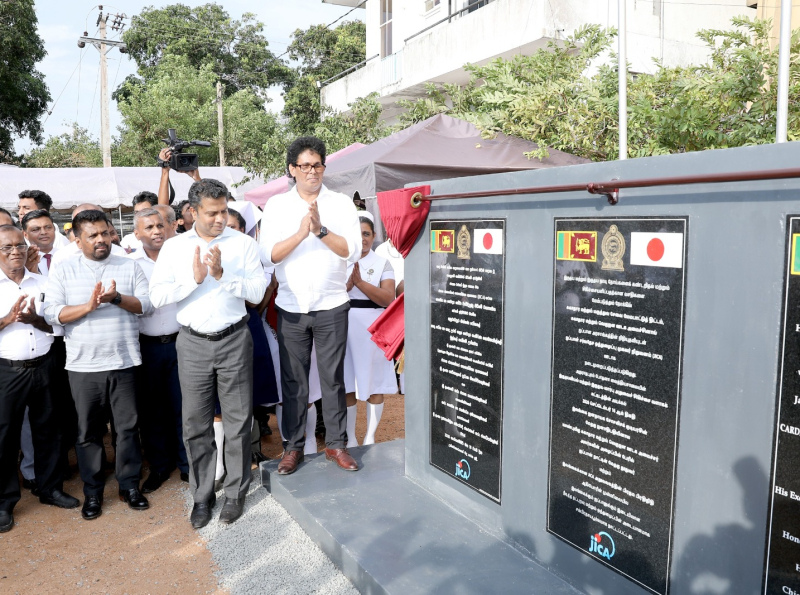
President Anura Kumara Dissanayake made these remarks while joining the commencement of construction work on the new modern Cardiac Care Complex at the Anuradhapura Teaching Hospital this afternoon (16).
Constructed at a cost of Rs. 3,545 million with loan assistance from the Japan International Cooperation Agency (JICA), the eight-storey Cardiac Care Complex will provide the people in the area with free access to state-of-the-art cardiac and cardiothoracic surgical treatment. The complex will comprise a range of facilities, including state-of-the-art Coronary Care and Intensive Care Units (ICU), Catheterisation Laboratories, X-ray and ECG facilities, specialised clinics, ward complexes, laboratories, an auditorium and a library.
Speaking on the occasion, President Anura Kumara Dissanayake further stated that projects worth approximately Rs. 19,000 million are planned to be commenced in 2027 and 2028 for the development of the Anuradhapura Hospital and that, together with the projects currently underway, a substantial investment of nearly Rs. 34,000 million is being made for the development of the Anuradhapura Hospital.
The President also pointed out that the failure to complete certain development projects initiated in the past within their stipulated timeframes had a significant impact on the country and its economy. He expressed confidence that the relevant parties would successfully complete the construction of the new Cardiac Care Complex within 18 months and make it available to the public.
Speaking further, President Anura Kumara Dissanayake stated:
“Today, we laid foundation stones for several essential construction projects at hospitals in the districts of Mannar, Mullaitivu, Trincomalee and Anuradhapura.
We all know that our country’s economy had undergone a severe collapse. When an economy collapses, its impact is not confined to the economic sphere. When the budget deficit increases significantly, when our foreign reserves are severely depleted, or when government revenue declines substantially, the ultimate consequence is a significant impact on the living standards of the people. Therefore, I believe that, as a nation, we experienced the consequences of such a catastrophe several years ago. It caused immense hardship to the people.
The situation became so serious that questions arose as to where our country’s economy would ultimately end up. At that time, an economist told me, ‘Our economy is collapsing down a mountain and the destruction is so severe that it is impossible to say where it will stop.’ He said the crisis would end with ‘people who travel by vehicle switching to bicycles, and children who travel to distant schools being sent to schools in their own villages.’ We faced an economic crisis of such uncertainty. That economic crisis created a major social tragedy and brought about a significant political transformation. The present Government came into being as a result of that political transformation.
Our fundamental challenge was how to stabilise the economy that was undergoing a collapse. By now, a number of very important stable positions have been recorded across all the key indicators of the country’s economy. Today, as a country, we can say that we have a strong economy. I saw that recently the World Bank classified us as an upper-middle-income country. These may be positive indicators for us. However, what the people need to know is whether the achievements we have made have contributed to improving their quality of life. Ultimately, people assess whether the economy is performing well or poorly based on how much easier their lives have become. Therefore, our focus now is on ensuring that the economic achievements we have made are translated into tangible benefits for the people.
If we are to improve the lives of the people, we need to provide good services. In terms of these services, I believe there are several that are particularly important. One of them is transport. I believe that, in next year’s Budget, the largest allocation has been made for the development of roads and transport facilities.
The next important area we have focused on is education. We are making a significant effort to transform education in this country. We are aware that there are some objections. Around the world, it is always difficult to move people away from established practices. When efforts are made to break away from such practices, resistance emerges. However, if we had remained within those same practices, human society would not have developed to where it is today. It was by freeing people from the practices of the time, whether under political authorities, leaders or tribal leaders, that human society transformed into a developed society.
Therefore, some people are attempting to confine society within old and regressive practices. However, we are a progressive and forward-looking political movement. Therefore, by facing these challenges, we will bring about a comprehensive transformation in the education sector. Otherwise, I do not believe that we will be able to improve the lives of the people in our villages.
The next most important aspect is a healthy life. Whatever else we may have, it is of no use if we are destined to lead unhealthy lives. If we fall ill and do not have access to convenient medical services, the other forms of wealth we possess have little meaning. Therefore, our most important wealth is a good and healthy life. Accordingly, our Government has placed significant emphasis on ensuring healthy lives for the people and we have identified three areas of focus to expand the services required for this purpose.
The first is to bring free healthcare services even closer to the people. We already have a network of rural hospitals. However, can we bring these services even closer to the people in our villages? That is why we have launched the “Arogya” programme.
In particular, advances in science and technology have enabled the world’s healthcare sector to make significant strides in recent years. Therefore, we cannot continue to rely on out-dated equipment, out-dated technology and out-dated nursing practices. We must bring the latest and most advanced equipment and medical practices available in the world to our country. Therefore, our second objective is to create an improved and advanced healthcare service. Our third objective is to establish a highly effective management system.
Accordingly, we have focused on three key areas: bringing free healthcare services even closer to the people, bringing the world’s most advanced equipment and medical practices to Sri Lanka and establishing a systematic management system.
We have had a very bad experience and that is the damage caused by delays in our projects. This damage occurs in two ways. First, we have invested funds, but there is a delay before we can obtain the services intended from that investment. That is a loss. Secondly, we have invested funds based on an estimate made at the time, but due to the delay, the cost increases significantly. That is also a loss.
The Minister of Health told me that a project in the Ministry of Health, which was estimated at Rs. 28 billion, now has a revised estimate of Rs. 58 billion. This means that if we had been able to complete it at the time for Rs. 28 billion, we would have spent Rs. 28 billion, whereas today it will cost us Rs. 58 billion. That means an additional Rs. 30 billion, which is more than double the original estimated cost. In other words, we could have undertaken another substantial amount of work with the additional funds now required.
I am particularly aware that the economic collapse was a major reason for this situation. To some extent, the economic collapse created obstacles for us. It is easy to start a new project, but a project that has been disrupted becomes a major complication. I believe that the Secretary, the Minister and our officials have made a tremendous effort and have now resolved a significant part of this situation.
This means that, at this particular moment, the consequences of not completing these projects have had a significant impact on the country and the nation. Therefore, I asked again today when this project would be completed. He said that it would be completed within 18 months. Accordingly, we expect this project to be completed within 18 months.
When we talk about the health sector, one of the key areas in which we are making a significant effort is the development of human resources. I have great confidence in the Anuradhapura Hospital. My mother was also admitted to this hospital for treatment on approximately three occasions about a month ago. There are very good doctors, nursing staff and support staff here.
The recruitment of doctors had been delayed for a considerable period in the past. However, for the first time in the history of Sri Lanka, we recruited 3,000 doctors for their first internship training within the three months of August, September and October. This is a very important step.
A total of 64 dental surgeons have been recruited. To the nursing staff, which provides an invaluable service to the health sector, 3,978 personnel have been recruited so far and arrangements are being made to recruit a further 2,820 by 31 October. Accordingly, a total of 6,788 personnel will be added to the nursing staff during this period.
At present, 4,869 student nurses have been recruited for nursing training and a further 3,000 will be recruited to nursing colleges by January 2027. Accordingly, there will be an overall increase of 7,869 personnel in the nursing sector within our state hospital system.
A total of 1,860 health assistants have been recruited so far and the Ministry has made arrangements to recruit a further 1,100 by January 2027. A total of 306 personnel have been recruited for para-medical services, while a further 301 are undergoing training. A total of 1,380 personnel have been recruited for allied health services, while 303 are undergoing training.
After a considerable period, we are taking steps to provide the maximum human resources required to maintain free healthcare services in Sri Lanka. I greatly appreciate the immense effort and service rendered by the entire healthcare workforce in our country, including doctors, in their dedication to patients.
Similarly, a number of major development projects are currently being implemented at the Anuradhapura Teaching Hospital. A total of Rs. 8,035 million has been allocated for the construction of the eight-storey Cardiology and Cardiothoracic Surgery Complex, comprising Rs. 3,545 million for construction and Rs. 4,490 million for equipment.
The medical supplies storage complex is valued at more than Rs. 1 billion. A further Rs. 1,186 million is being spent on the Intensive Care Unit and medical ward complex.
Plans are in place to commence development projects worth Rs. 19 billion (Rs. 19,000 million) for the Anuradhapura Hospital alone in 2027 and 2028. Work worth Rs. 9.7 billion is already underway. Including the Rs. 19 billion in projects planned for commencement and the projects currently underway, we have made arrangements to allocate funds for a substantial overall investment of nearly Rs. 34 billion (Rs. 34,000 million) for the development of the Anuradhapura Hospital. Our sole objective is to provide the maximum possible service to the people through systematic management.
Secretary to the Ministry of Health and Mass Media, Specialist Dr Anil Jasinghe:
Non-communicable diseases are responsible for 80% of all deaths occurring in our country. Among these 80% of deaths, high blood pressure and diabetes are the leading causes. We refer to these as NCDs (Non-Communicable Diseases).
The main issue is that these two diseases are interconnected and cause numerous complications in a person’s health. Looking at the current situation in Sri Lanka, only around 50% of those suffering from high blood pressure are under effective control. Similarly, only small proportions, around 25%, of people with diabetes are under proper control. As a result of this situation, it has now become a major problem within society.
The most serious complication associated with both these diseases is MI, or myocardial infarction, commonly known as a heart attack. This has also become the most significant complication. Therefore, how do we control this modern epidemic? This is the greatest challenge before us.
While establishing modern facilities across the country, our healthcare system also needs to recognise the changes that have taken place in the demographic structure of our population and in disease patterns. Accordingly, our healthcare system must also be adapted to appropriate mechanisms to address these changes.
In accordance with the policies of the Government led by the President and under the guidance of the Minister of Health, the Ministry of Health and Mass Media is currently implementing such a comprehensive programme. It has three main components. Moving forward, it will be important to develop “Arogya”, Cluster Systems and High-End Care Institutions in a manner suited to our healthcare system.
Japanese Ambassador to Sri Lanka Akio Isomata:
“It is a great honour for me to participate in this occasion to lay the foundation stone for the new Cardiology and Cardiothoracic Surgery Complex building at the Anuradhapura Teaching Hospital. I extend my heartfelt appreciation to the Hon. President, the Hon. Ministers and all Sri Lankan stakeholders who worked with dedication to make this occasion a success today.
Japan has a long history of cooperation with Sri Lanka in the healthcare sector. Cardiovascular diseases account for 32% of all deaths worldwide, while the proportion of deaths attributed to cardiovascular diseases in Sri Lanka is higher by comparison. Cardiovascular diseases are also the second leading cause of death in Japan. Therefore, we have sought to share our experience and knowledge in addressing this situation with Sri Lanka by providing support in the form of physical infrastructure and training for medical professionals.
Japan is proud to be a long-standing and trusted partner of Sri Lanka, and I believe that this project will further strengthen the friendship and partnership between our two countries. Japan will always be ready to support the efforts of the Government of Sri Lanka to improve medical infrastructure and achieve a sustainable healthcare system.”
Minister of Health and Mass Media Dr Nalinda Jayatissa, Minister of Trade, Commerce and Food Security Wasantha Samarasinghe, Minister of Housing, Construction and Water Supply Dr Susil Ranasinghe, Governor of the North Central Province Wasantha Kumara Wimalasiri, Members of Parliament, Secretary to the Ministry of Defence, Air Vice Marshal Sampath Thuyacontha (Retired), heads of the security forces, officials of the Ministry of Health, representatives including Chief Representative of the Sri Lanka Office of the Japan International Cooperation Agency (JICA) Shigeo Honzu, the hospital director and staff were present at the occasion.