
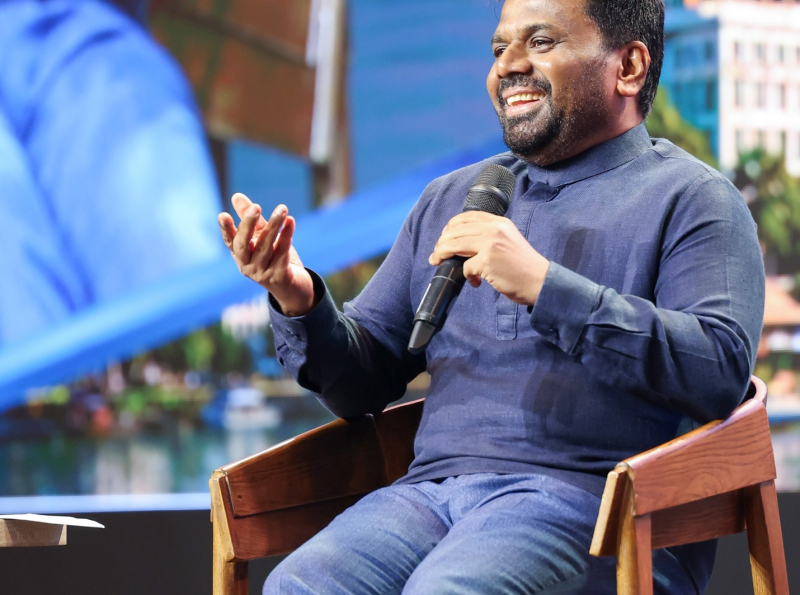
“Invest in Sri Lanka with Confidence: We Have Built an Investor-Friendly and Secure Environment” — President
President Anura Kumara Dissanayake invited the local and international business community to invest in Sri Lanka with confidence, stating that the Government is committed to maintaining transparent governance, enacting the necessary laws and regulations, and developing essential infrastructure to create a favourable environment for investment.
The President made these remarks when he attended the Sri Lanka Economic and Investment Summit 2026 at the Shangri-La Hotel in Colombo yesterday afternoon (12). The summit is drawing national and international attention to Sri Lanka’s economic reforms and investment opportunities.
Organised by the Ceylon Chamber of Commerce, the summit is being held under the theme “Positioning Sri Lanka in a Changing Global Economy: Resilience, Reform and the Future of Economic Policy”. The summit concludes today (13).
The summit, attended by representatives of the public and private sectors, policymakers, the business community and international investors, focuses on opportunities to attract foreign direct investment, expand exports and achieve sustainable economic growth. Its main objectives are to showcase Sri Lanka’s investment potential internationally and strengthen public-private sector cooperation to support the country’s long-term economic development.
The questions raised at the summit and the answers provided by President Anura Kumara Dissanayake are as follows.
Q. A special programme is currently being implemented to strengthen the rural economy and eradicate poverty. In addition, nearly five million people receive Aswesuma benefits. How can we integrate this group into the mainstream economy?
Answer
Our main challenge is to eradicate rural poverty. A recent World Bank report stated that rural poverty stands at 16.9 per cent. This is not something that can be completed within a year or two, as one might build a building or construct a road. It requires a targeted programme supported by a continuous, long-term plan.
Every country has vulnerable groups whom the Government must look after. This cannot be ignored. Not everyone can become a participant in the mainstream economy. Every country has social groups that must be supported through some form of social safety net.
Our problem is that this group is very large. There are several reasons for this. One is the failure to create new economic opportunities for rural people. Their economic opportunities are extremely limited. They are generally confined to agriculture, marine and inland fisheries, or operating small businesses in local markets.
Therefore, if we are to eradicate rural poverty, our first challenge is to determine how we can create new economic opportunities for rural communities.
For a long time, our agriculture sector has operated at a subsistence level rather than as part of a commercial economy. We must therefore use agriculture to ensure food security while creating new economic opportunities for rural people.
When people try to create economic opportunities for themselves, they face obstacles because they lack capital, access to modern technology and the ability to reach markets. It is our responsibility to provide these facilities. We have already launched a collateral-free loan scheme.
Through this scheme, introduced for rural entrepreneurs who lack capital and assets, we have provided nearly Rs. 18 billion and helped establish new enterprises.
We must also integrate new technology into these ventures and channel the wealth generated by the Government towards rural communities.
We are pursuing two strategies in this regard. First, we need a rural development pathway. In this year’s Budget, we have allocated Rs. 35 billion for the development of small tanks and irrigation canals. We have also allocated Rs. 25 billion for the Praja Shakthi rural development programme. Including Rs. 24 billion allocated through the Road Development Authority for rural roads, nearly Rs. 100 billion has been channelled directly towards rural communities.
Our economic strategy is also to pursue development while enabling people to remain in their villages. Accordingly, the 2027 Budget places greater emphasis on establishing a rapid communications network and an improved road system connecting villages and towns.
These are the kinds of programmes through which rural poverty must be addressed. There is no solution that can be introduced today and deliver results tomorrow. This requires a long-term programme supported by a continuous plan. We have already begun this process.
Question 2: Reducing the Time Taken for Investment Approvals
How can we reduce the time taken to approve investment projects?
Answer
In the forthcoming Budget, we have planned capital expenditure of Rs. 2 trillion. This represents a substantial increase compared with previous years.
In 2023, the Government spent only 64 per cent of the capital expenditure allocated. In 2024, the figure was 54 per cent. Despite the elections and natural disasters in 2025, we managed to increase this to 76 per cent.
There was a prevailing perception in our country that the state machinery was always engaged in corruption and that laws had to be enacted to prevent it. Over the years, however, laws introduced step by step to prevent corruption have become so stringent that it is now difficult to carry out any task quickly.
The old system was designed solely for purchasing goods. But are we still purchasing only goods? We now procure solutions through software systems, for example. Yet our procurement procedures do not accommodate such arrangements.
Our intention is therefore to identify these specialised areas and establish new procurement procedures. We have identified several specialised and emerging fields for which new procurement systems need to be introduced, and we are giving these matters our attention.
Previously, procurement procedures began only after the Budget had been approved and the relevant funds allocated. In most cases, procurement activities were completed around August or September.
We have now addressed this problem. The Treasury Secretary can confirm that the funds will be allocated, enabling tenders to be called and suppliers selected in advance.
One example is the Kurunegala–Galewela expressway. We expect to award the tender by January. We have planned a number of major projects along these lines.
We must also move towards electronic procurement. In addition, we are taking steps to retain specialists within the public service by placing them on special salary scales. These measures will enable us to bring capital expenditure close to 100 per cent.
Question 3: New Laws on Customs, Labour, Public-Private Partnerships and State-Owned Enterprises
Recently, there has been discussion about customs laws, labour laws, legislation governing public-private partnerships, and laws relating to the management of state-owned enterprises. What is the current status of these measures?
Answer
The law relating to state-owned enterprises (SOEs) will be submitted to the Cabinet in about two weeks. It can then be gazetted promptly.
The legislation on public-private partnerships has been drafted by the Legal Draftsman’s Department and forwarded to the Attorney General. We will be able to proceed on the basis of the Attorney General’s recommendations.
Our labour laws are currently contained in approximately 12 Acts, with provisions spread across several different pieces of legislation. A draft law has already been prepared. Although some time has passed, we will review it again very soon.
I also saw that the Chamber of Commerce had submitted its views on the Customs Ordinance. The Customs Department has also put forward its views. After a long period, we have now been able to reach an agreement.
The most appropriate proposal is to amend the Customs Ordinance. I understand that the proposals have already been sent to the Legal Draftsman’s Department. It will prepare and submit the legislation shortly.
We expect that all these laws can be passed by Parliament, most likely in January or February.
Question 4: Tourism Promotion and Procurement Procedures
We have discussed the need to implement promotional programmes for the tourism industry in regional countries. Are you saying that our procurement process is an obstacle to this? Why can’t funds be allocated for these activities?
Answer
Yes. How do we procure a promotional plan? Under our procurement procedures, we can purchase a desk. But what exactly is a promotional campaign? It is an idea. How do we purchase an idea? Our procurement procedures must be designed to accommodate such requirements.
People may say that similar activities were carried out in the past. But how were they carried out? Who says they were done that way? The organisation selected is not necessarily the one that proposes what is considered the best option. So, who evaluates the proposal, and how is it measured?
Efforts have been under way for about a year and a half to implement this promotional campaign. The Tourism Authority says it will call for tenders in January. In addition, it has started small-scale promotional projects in five countries.
There is also a proposal submitted by businesses operating in the tourism sector, which we are considering.
Under this proposal, if these businesses bring in a certain percentage more tourists next year than they brought in this year, we will allocate funds in the next Budget for the Tourism Authority to make payments in respect of the tourists brought in above the agreed target.
Question 5: Renewable Energy, Battery Storage and Transmission Infrastructure
The Government has placed special emphasis on renewable energy. We have seen work being undertaken to increase battery storage capacity. We believe that the private sector should also participate, alongside household solar power initiatives.
Can we expect revisions to payment mechanisms in the future? What are your views on improving the transmission network? It has been suggested that this could cost Rs. 4 billion to Rs. 5 billion.
Answer
The Sri Lankan Government intends to establish a high-voltage transmission system from Kilinochchi to Habarana with the assistance of the Asian Development Bank.
In addition, several other transmission systems have been identified, including Puttalam–Wariyapola and Habarana–Veyangoda. We plan to have these constructed through the private sector.
Until now, all transmission systems in Sri Lanka have been built by the Ceylon Electricity Board. We intend to attract private investment into transmission infrastructure. We have already selected four grid lines for this purpose and will call for tenders for them very soon. This will enable the private sector to participate in developing the transmission network.
We are also focusing on the energy sector. There are two main considerations: the stability and continuity of the energy supply, and the cost of energy. Our energy policy is based on these two factors.
Take the feed-in tariff system, for example. It is not a competitive tendering process. Instead, we purchase electricity at a rate determined by the Public Utilities Commission of Sri Lanka (PUCSL). This system has been used for a long time.
However, if our second strategy is to reduce the cost of purchasing energy, relying on this system is not the right approach. Rather than purchasing electricity at a predetermined rate, we can obtain it at a lower price through an open and competitive tendering process.
For example, when we assumed office, there was a power project in Mannar for which we had agreed to purchase electricity at 8.22 US cents per unit. We negotiated with the company and informed it that we were prepared to proceed if the price could be reduced to below five US cents. However, the company did not agree to that price, and the agreement was terminated.
Subsequently, we called for tenders for two projects of 50 megawatts each. The first 50-megawatt project was awarded at 3.96 US cents per unit, while the second 50-megawatt tender resulted in a price of 3.74 US cents per unit.
This is the kind of competition that brings us greater benefits.
Therefore, rather than relying on feed-in tariffs, we are focusing on meeting our generation requirements through competitive procurement.
There was a perception that we were a Government opposed to renewable energy. When we took office, the country's total solar power capacity was only 1,400 megawatts. However, over the past two years, we have added another 1,500 megawatts. We have also entered into agreements for a further 1,100 megawatts, which are expected to be completed by next year.
This means that 2,600 megawatts of additional solar power capacity will have been developed under our Government.
Another consideration with renewable energy, particularly solar power, is land use. Generally, one megawatt of solar power requires approximately three and a half acres of land. In a small country like ours, we must consider whether allocating so much land for solar power generation is the best approach.
That is why we are exploring floating solar systems on reservoirs. We have already commenced a five-megawatt floating solar project at Ibbankatuwa.
The entire Ibbankatuwa reservoir covers approximately 1,000 acres, but only 10 acres were required to generate five megawatts. That is just one per cent of the reservoir's area.
In other words, we were able to generate five megawatts of electricity by using only one per cent of the reservoir, without occupying additional land. This is why we are paying greater attention to floating solar systems.
We have now begun work at Randenigala. We intend to invite the private sector to tender for both the environmental impact assessment (EIA) and the construction of the generation system.
We also intend to introduce floating solar systems at several selected reservoirs, including Moragahakanda, Samanalawewa and Chandrika Wewa. We want to move further towards renewable energy.
The particular challenge with electricity is that, unlike other goods, it must be generated and consumed at the same time. Most other goods can be stored, but electricity presents a different challenge.
Solar power generation is strongest during the daytime. This creates a problem because available capacity can exceed demand during those hours, forcing us to curtail some purchases of electricity. This has attracted considerable criticism.
However, power system management experts point out that we have excess capacity during the daytime. If that is the case, we should store solar energy generated during the day and use it at night.
We have already called for tenders for 160 megawatts of battery storage capacity. I believe that 13 units will be completed by November, with the remaining three also expected to be completed.
We have also called for tenders for another 250 megawatts of battery storage capacity, and the bids are currently being evaluated. I am pleased to say that, based on the information available from the evaluations so far, the prices for this 250-megawatt capacity are 10 per cent lower than those obtained for the 160-megawatt battery tender.
Next, we intend to tender for a further 150 megawatts of capacity, allowing existing solar power owners to participate.
We are also aware of the concerns surrounding rooftop solar systems installed in households. Tax concessions are available for batteries with a capacity exceeding one megawatt, while batteries below that capacity are subject to tax. This discourages smaller-scale users.
We are considering whether tax concessions could be extended to batteries below one megawatt. However, there is a technical challenge: how do we distinguish, from a technical standpoint, between batteries used to store solar energy and other types of batteries?
If we can resolve this issue, we will be able to take appropriate action.
At present, 69 per cent of the country's total electricity generation capacity comes from renewable sources.
On some days, including yesterday, renewable energy accounts for between 70 and 75 per cent of our electricity generation. This varies according to daily conditions.
For four consecutive days recently, we did not use a single litre of diesel to generate electricity.
Our progress towards renewable energy has therefore been highly successful, and it will be a significant achievement.
Our objective is to ensure a continuous supply of energy at a reasonable price. These are the two principles guiding our work.
Question 6: Increasing the Economic Contribution of Ports
In a country such as Singapore, port revenue contributes approximately 7–8 per cent of gross national income. In Sri Lanka, however, the contribution is still only around 2–3 per cent. Why is this the case?
Answer
Ports are one of the most important components of our economic strategy.
The Sri Lanka Ports Authority currently controls the East Container Terminal. At present, approximately 500,000 containers are handled there. However, the terminal has the capacity to handle 3.2 million containers.
This means that we are not making full use of this asset on a daily basis.
I do not believe that the Government can continue to manage the East Container Terminal entirely on its own. The Cabinet has therefore decided to retain ownership of the terminal while establishing a company to manage it and transferring shares in that company to private investors.
Several major international shipping companies are currently in discussions regarding the management of the East Container Terminal.
The next project is the second phase of the West Container Terminal. A breakwater needs to be constructed for this phase. The estimated cost was previously US$1.1 billion, but it has now risen to US$1.4 billion.
If we undertake this expenditure and construct the breakwater, the West Container Terminal will also be able to handle 3.2 million containers.
The next Budget will allocate funds for preliminary studies. The Asian Development Bank is already preparing the feasibility study. An interim report is expected by December, followed by the complete report by next April.
We intend to develop the terminal system in this manner.
We must also consider whether ports should be limited to the transhipment of containers. Is there more we can do beyond that?
We can develop the port into a logistics hub. In the past, several problems arose during the tendering process for such a project, and the matter eventually ended up in court.
All those issues have now been resolved. An agreement has been reached to conclude the matter by paying the compensation due to the companies concerned.
We are also taking steps to construct a yard with a capacity of 150 bases at Kerawalapitiya to reduce container congestion within the port.
There is also a tax-related issue concerning bunkering. We are examining this matter and hope to provide relief in the forthcoming Budget.
Since this is an international trade activity, taxation must be imposed in accordance with international standards.
Question 7: Creating Employment Opportunities in Emerging Technology Industries
Five or six years ago, one of the main challenges in emerging technology industries such as big data, artificial intelligence (AI), quantum computing and blockchain was the shortage of skilled workers.
Today, approximately 17,000 people enter this field each year from State and private universities, but there are not enough jobs for them. This is not a problem unique to Sri Lanka. How can we advance the technology sector?
Answer
The real question is: what level of competence have we achieved in the skilled workforce we are producing? At present, most of these workers are at an intermediate level. That is where the employment crisis has emerged.
If they can advance to higher levels of expertise, employment opportunities will increase further.
Employment opportunities in the public sector will expand significantly. The domestic industrial sector also needs skilled professionals.
I believe we can bring about the necessary change if we transform the entire system. This is a challenge we must address.
We are considering establishing an AI training centre. Next week, we hope to establish an AI centre in Wijerama in collaboration with Singapore. We expect to obtain Cabinet approval for the relevant Cabinet paper next week.
We believe that the solution to this crisis lies in raising the level of skills and expertise.
We are also examining several other areas, including how to expand online working arrangements through institutions such as business process outsourcing (BPO) companies and how to create more international employment opportunities.
These initiatives will help us find solutions.
Even degree programmes must be upgraded. Initially, we had a particular level of IT engineer in mind. However, despite the substantial growth of the IT sector, we have failed to produce graduates with the skills now required by the industry.
Our IT sector must therefore move up two or three levels. That is the only solution.
Question 8: Fuel Subsidies and the Economic Impact of the Middle East Conflict
President, the Middle East crisis has created difficulties for us, and a subsidy is currently being provided for diesel. If the war in the Middle East continues for longer, will we continue providing this subsidy for as long as two years, or will we move towards targeted economic stimulus measures?
Answer
When the war in the Middle East began, our main challenge was to maintain an uninterrupted supply of energy, including fuel, electricity and gas.
In many countries around the world, disruptions to these supplies led to social unrest. We successfully ensured continuity of supply in Sri Lanka.
No indicator can reliably predict how long this war will continue.
Our economy and society are recovering from a severe economic crisis and the collapse of businesses. We could not afford to withstand another major shock. That is why we introduced the Ditwah relief package.
As a result, we were able to achieve economic growth of 5.2 per cent in the first quarter.
During the first five months, we spent Rs. 60 billion to provide a subsidy of Rs. 100 per litre of diesel and Rs. 20 per litre of petrol.
Although no subsidy was provided in September, the situation subsequently intensified again. We are therefore providing a subsidy of Rs. 70 per litre of diesel for October, November and December, at a cost of Rs. 41 billion.
The subsidy should reach the targeted groups, such as farmers using tractors for cultivation and traders delivering bread.
However, weaknesses in the direct data system have made it necessary to provide a general subsidy. Going forward, we will discuss the matter with Dialog and Mobitel to develop a mechanism through which the subsidy can be provided only to the intended beneficiaries.
We invited private-sector companies to compete in the fuel market. However, private companies have not supplied fuel at the prices offered by the Ceylon Petroleum Corporation (CPC).
The CPC has made a profit of Rs. 28 billion and is prepared to share part of that profit with the public in the form of relief. However, private companies have been keeping fuel in storage and restricting distribution.
It is not fair to pass on a price difference of Rs. 132 per litre of diesel to the public.
We have therefore decided to establish 75 new petrol stations through the CPC in areas where private companies have restricted supplies.
No company has the right to place the energy sector, which is essential to the country's social and economic functioning, in a state of uncertainty or to stop fuel distribution.
Private entrepreneurs must demonstrate not only a commitment to profit but also a sense of social responsibility.
Question 9: A Possible New International Monetary Fund Programme
The Government has entered the final six months of its programme with the International Monetary Fund (IMF). Although the programme has brought many benefits following debt restructuring, what is the Government's position on entering a new IMF programme in the future?
Answer
Although we have moved up in credit ratings, our foreign reserves still need to increase to the expected level. If we can fulfil these requirements, we will be in a position to proceed.
However, amid global uncertainty, the cost of fuel imports has risen considerably.
Last year, the cost of fuel imports was US$4.042 billion. During just the first eight months of this year, it rose to US$4.082 billion.
Based on this trend, fuel imports could cost approximately US$6 billion by the end of the year. This presents a major challenge for the economy.
The primary objective of the first four-year Extended Fund Facility (EFF) programme with the IMF was to achieve economic stability.
We have successfully achieved that stability. The next step is to preserve it while achieving economic growth.
If we can reach a new agreement that supports this growth, we are prepared to proceed.
There was no major contradiction between the Government's economic vision and the conditions agreed with the IMF. This enabled us to complete the four-year programme successfully without conflict.
A team of economic experts, including officials from the Ministry of Finance and the Governor of the Central Bank, is discussing the form that the next programme should take.
We expect to reach an appropriate decision during the remaining six months, taking external economic shocks into account as well.
Question 10: The President's Final Message to Investors
There are many foreign investors, local and foreign ambassadors, members of the business community, representatives of chambers of commerce and government officials here today. What is your final message to us?
Answer
We have established the transparency required within the country. That was the first step.
The second step is to establish the laws and regulations necessary to ensure investment and business security and protection. A substantial part of this work is now in its final stages.
We are also developing the infrastructure required for investment.
The Government's responsibilities are to establish transparency, enact the necessary laws and regulations, and develop infrastructure.
We will do our part. You must do yours.
There were some doubts and questions recently about the removal of the Simplified Value Added Tax (S-VAT) system. However, the S-VAT system had been resulting in a revenue leakage of Rs. 10 billion per month, and we have now successfully brought this under control.
We want to create a strong domestic business community and a new generation of entrepreneurs capable of successfully partnering with foreign investors and major international companies operating in Sri Lanka.
Our Budget also focuses on this objective. In particular, we are prepared to offer concessions relating to land and certain services to those investing in rural areas.
At the same time, infrastructure development in several sectors, including ports, renewable energy, Port City and tourism, is creating new economic opportunities.
I urge all of you to invest without fear. We will provide the protection and confidence necessary for you to do so.That is my final request to you.