
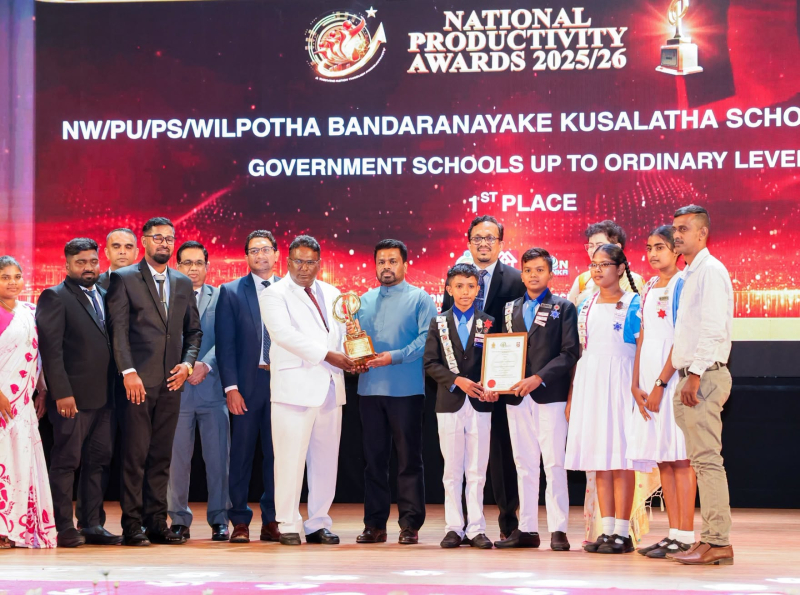
The National Productivity Awards 2025/26 ceremony, organised by the National Productivity Secretariat under the Ministry of Industry and Entrepreneurship Development to recognise excellence in the public, school, manufacturing and service sectors, was held yesterday (08) afternoon at the Bandaranaike Memorial International Conference Hall (BMICH) in Colombo under the patronage of President Anura Kumara Dissanayake.
The President presented Gold Awards to institutions that demonstrated outstanding performance in productivity, innovation, efficiency and continuous improvement.
First introduced in 2003 and held biennially, the National Productivity Awards competition was conducted this year for the first time since 2021. A key feature of this year’s competition was its alignment with the Government’s flagship national programme, Clean Sri Lanka.
The competition aims to encourage institutions in the public, school, manufacturing and service sectors to adopt best practices, utilise resources efficiently and improve the quality and productivity of their services and products.
The awards are presented under three main categories: the public sector, the school sector, and the manufacturing and service sectors. The evaluation criteria include leadership, strategic management, human resource development, stakeholder relations, operational processes, innovation, digitalisation and measurable productivity outcomes.
The evaluation framework also incorporates the three main pillars of the Clean Sri Lanka programme – social, environmental and ethical considerations. Special attention is given to employee welfare, community participation, waste management, energy efficiency, green productivity, transparency, accountability and ethical governance.
Addressing the ceremony, Minister of Industry and Entrepreneurship Development Sunil Handunnetti said that although productivity was not a familiar concept in Sri Lankan society, the country had an opportunity to bring it back into public discourse through this recognition programme.
He noted that for several decades, inefficiency had been widely discussed and had become an accepted feature of society. Therefore, properly understanding and implementing productivity concepts was essential to building a productive society through the efficient utilisation of limited resources.
The Minister also highlighted the importance of recognising the efforts of public servants, pointing out that they often worked hard to achieve their targets despite limited facilities.
“Rather than simply demanding more work from people, we should give greater recognition to the work they do,” he said.
He further stated that such recognition would help create a society in which employees were respected, entrepreneurs and industrialists were valued, and public servants could perform their duties with satisfaction.
The Minister emphasised that the awards should not be considered individual achievements alone, as they reflected the collective dedication and commitment of entire teams. He expressed the Government’s aspiration to establish the National Productivity Awards as the principal benchmark for measuring success in the public, private and school sectors.
Addressing the gathering, Secretary to the President Dr Nandika Sanath Kumanayake stressed that productivity and efficiency were essential for a developing country to achieve sustainable economic growth and improve living standards.
He explained that improving productivity was vital to attracting investment, strengthening international competitiveness, increasing wages and enhancing the quality of life of the people.
The Secretary to the President revealed that approximately 15 per cent of Sri Lanka’s total workforce was employed in the public sector, while around 26 per cent of government expenditure was allocated to it. However, the public sector’s contribution to Gross Domestic Product (GDP) remained at approximately five per cent.
He pointed out that low productivity in the public sector had contributed to a cycle that weakened individual performance, limited wage growth and reduced the sector’s ability to attract and retain skilled and talented employees.
To overcome this challenge, he emphasised the need to improve the efficiency of public officials through technology, automation and digitalisation.
He also highlighted the importance of developing human resource capabilities, attitudes and work practices, with particular emphasis on discipline, accountability, teamwork and improved concentration through concepts such as Deep Work.
Dr Kumanayake further noted that the Clean Sri Lanka programme directly supported efforts to enhance productivity by promoting positive behavioural changes among human resources and developing a more productive workforce.
He commended the decision to extend the productivity awards competition beyond the public and private sectors to include schools and youth groups, describing it as an important initiative to promote productivity across the country's workforce.
He also called for the further expansion of the competition in the future to encourage wider participation.
Minister of Science and Technology Professor Chrishantha Abeysena, Deputy Minister of Industry and Entrepreneurship Development Chathuranga Abeysinghe, Secretary to the Ministry of Industry and Entrepreneurship Development Thilaka Jayasundara, Director General of the National Productivity Secretariat Suranga Gunaratne and officials of the Secretariat were also present at the occasion.
Clarify the event dateTighten the opening paragraphUse a stronger news headline